Physics context
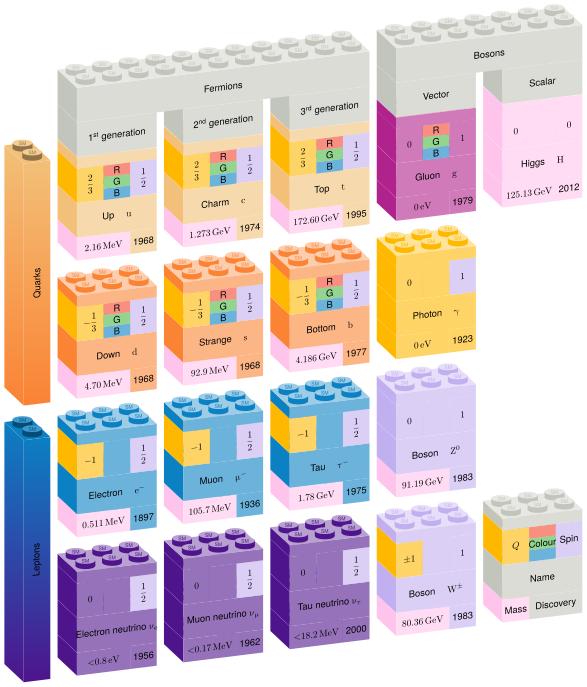
The cornerstone of the Standard Model, the theory widely accepted in particle physics, is the spontaneous breaking of symmetries, which predicts the appearance of a new scalar boson, the Higgs boson, discovered in 2012 at the LHC by the ATLAS and CMS experiments, and generates the mass of the vector bosons of the electroweak sector: the and bosons. Owing to this particular feature, these bosons are the only elementary particles to possess three polarisation states, including a longitudinal one in which they behave at high energy like the Goldstone bosons of the theory prior to symmetry breaking. The study of events produced through electroweak processes therefore provides a unique way to probe the fundamental structure of the Standard Model.
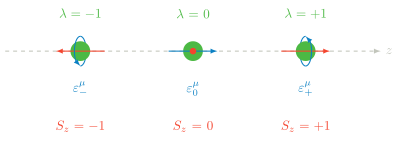
More: helicity and the three polarisation states
The polarisation describes the spin state of the vector boson with respect to a chosen spin-quantisation axis. In the helicity basis, this axis is chosen to be the direction of motion of the boson, and the helicity is defined as The polarisation states are labelled by the helicity eigenvalue . For a boson decaying into a lepton and a neutrino, the fractions of the three states are read from the angle of the charged lepton in the boson rest frame: with : is the longitudinal fraction and the transverse one.
Research axes
 2023 – 2026 · ATLAS Standard Model group
Polarisation in VBS WZ
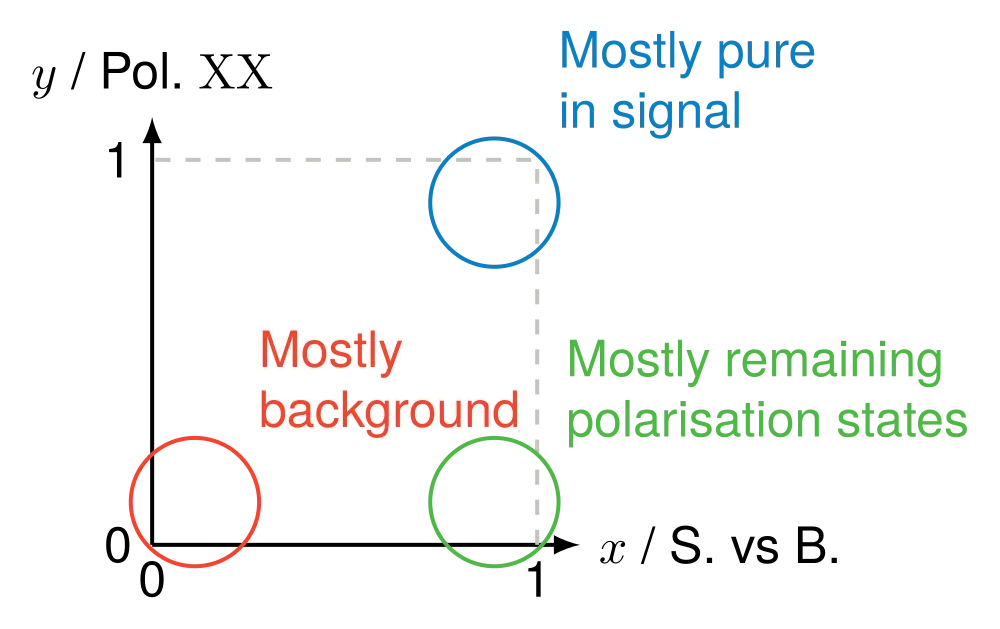
A signal-background DNN and a polarisation DNN combined into a two-dimensional template, binned with Voronoi regions: evidence at standard deviations for a longitudinally polarised Z boson. On arXiv:2607.20246, presented at ICHEP 2026.
Read more →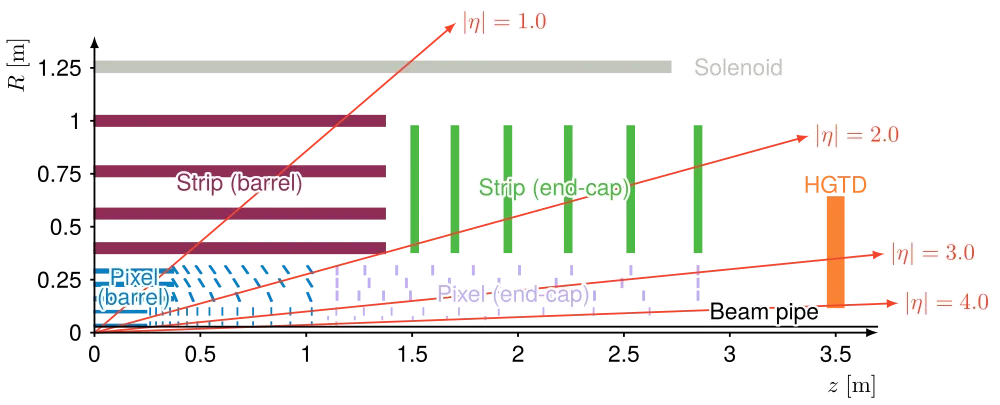 2023 – 2026 · ATLAS Combined Performance group
Forward electrons for Run-4
DNN-based working points and energy calibration for forward electrons, using the new ITk and HGTD variables up to , decorrelated from and implemented in Athena. Three ATLAS internal notes.
Read more →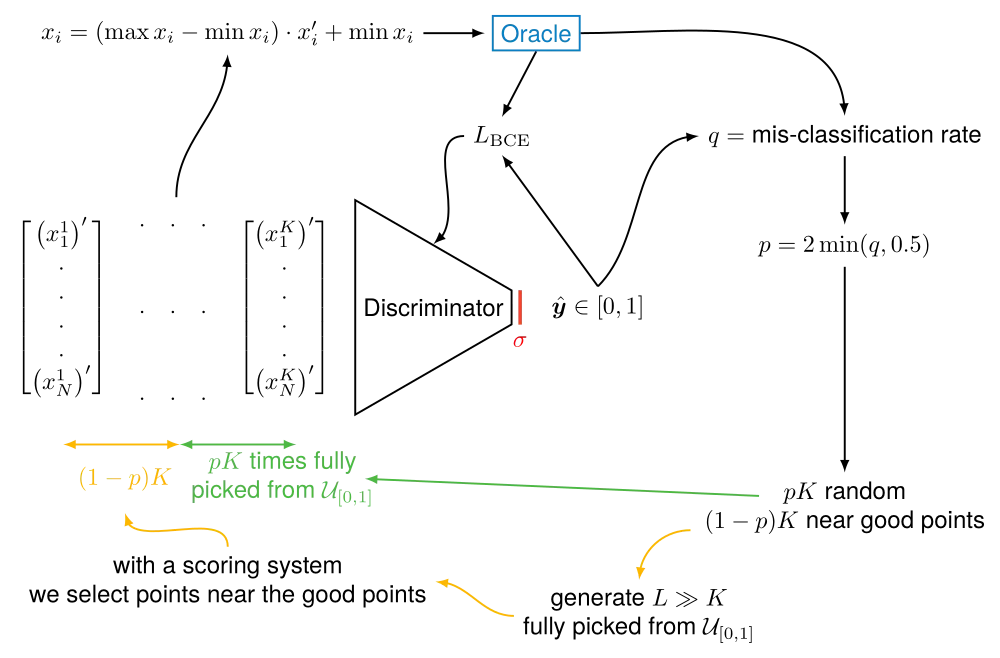 2023 – 2025 · with LAPTh
Active learning for BSM scans
Active-learning-driven neural networks to explore the high-dimensional parameter space of scotogenic models, compared with Markov-Chain Monte Carlo. Joint paper on arXiv:2512.06378, in submission to SciPost.
Read more →